Protecting Field Workers Operating in Hazardous Environments
DX-U2200 Provides Powerful Support by Meeting Diverse and Demanding Requirements
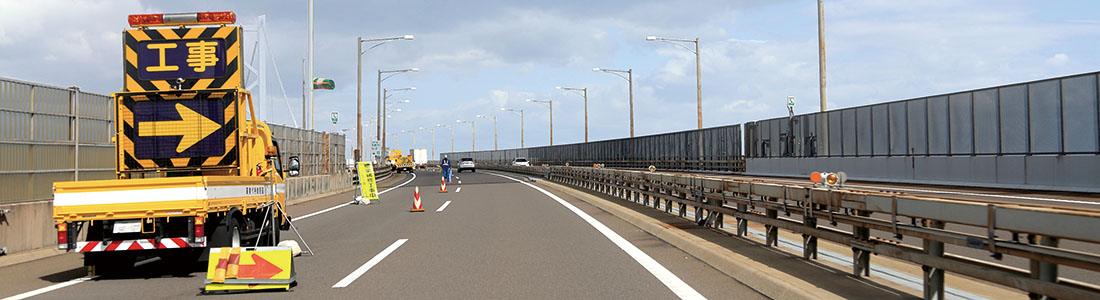
Workers engaged in the maintenance of highways—critical social infrastructure—are constantly exposed to the danger of high-speed vehicles passing close by.
“Highway Ai-MONITOR®” was developed through continuous efforts to enhance their safety.
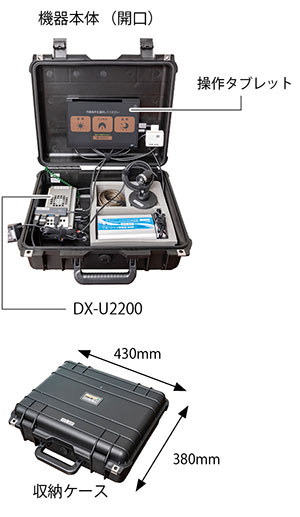
Serving as the core of this system, CONTEC’s DX-U2200 has been adopted as the edge AI computer, meeting a wide range of essential requirements, including vibration resistance, a broad operating temperature range, and stable long-term supply.
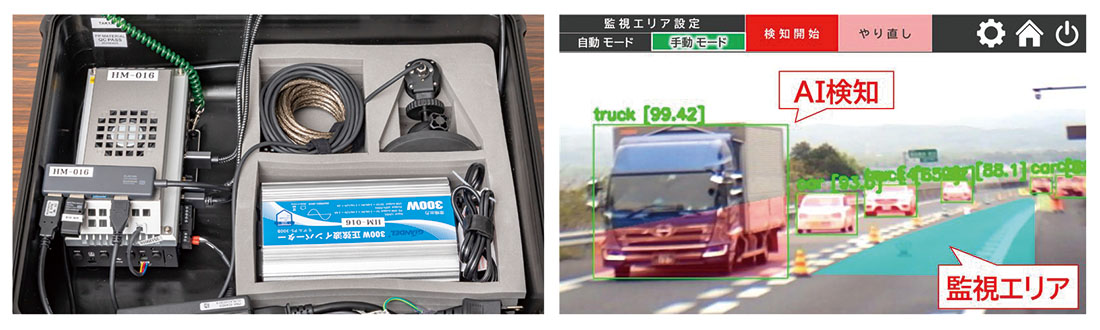 “Highway Ai-MONITOR,” which serves as the “eyes of the machine” at highway maintenance sites, provides a strong sense of reassurance to workers.
A critical issue in highway maintenance is ensuring the safety of workers.
Expressways are an indispensable part of social infrastructure, supporting the movement of people and the transportation of goods.
To maintain them, routine inspections such as checking for damage, repair work, and measures against deterioration are essential.
However, when maintenance is carried out under partial traffic restrictions, restricted areas are indicated only by arrow boards and traffic cones, placing workers in constant danger as high-speed vehicles pass by in close proximity.
“Ensuring the safety of workers is an ongoing, never-ending challenge, and we have implemented various countermeasures over the years.
For example, systems that use infrared sensors to detect intruding vehicles and alert workers with warning lights. However, on expressways, a vehicle traveling at 100 km/h can cover 100 meters in just about three seconds, meaning that even if danger is detected, there are situations where evacuation cannot be carried out in time.
We have always been driven by the question: is there a way to ensure worker safety not through human judgment, but through a system that can make decisions and detect intrusions at an even earlier stage?”
This is how Aoyama Yukiharu, General Manager of the Technology Development Department at Central Nippon Highway Engineering Nagoya Co., Ltd., explains the motivation behind the development of “Highway Ai-MONITOR.”
“We develop a wide range of equipment and products related to highway maintenance. One day, however, a software development partner proposed that if dangerous driving vehicles could be detected using AI-based object recognition, it might be possible to take preventive measures before a serious accident occurs.
To evaluate this idea, we tested an open-source object recognition model on an actual highway and found that it was able to almost accurately distinguish vehicle types traveling at 100 km/h.”
“This gave us confidence that even in cases where a vehicle enters a traffic-restricted area, it would be possible to detect it accurately and at a much earlier stage.”
With this realization, the development of “Highway Ai-MONITOR” officially began.
Addressing hardware-related challenges with the adoption of the DX-U2200
According to Aoyama, one of the greatest challenges during development was how to define the restricted area.
“On expressways, maintenance work carried out under traffic restrictions often progresses while gradually shifting locations, so it was necessary to set the work area both easily and accurately.
After repeated trial and error, we were able to develop a function that uses AI-based image recognition to automatically define the restricted area, addressing this challenge as well.”
Having overcome these challenges, the project moved from the prototype stage toward full productization—only to encounter yet another major obstacle.
“At the prototype stage, we had adopted an overseas-made edge AI computer, but that product was discontinued,” Aoyama recalls, reflecting on the situation at the time.
Securing a stable supply of an edge AI computer became an “indispensable and critical piece” for commercialization. It was during this search for suitable options that they came across the CONTEC DX-U2200.
“At the time of selection, since the system would be mounted on a vehicle and used outdoors throughout the year, we narrowed down our options based on two essential requirements:
(1) Compliance with vibration standards for in-vehicle use,
(2) A wide operating temperature range.”
“DX-U2200 met all of these requirements, and we also found its compact size to be highly appealing. Given that the product needs to be mounted in a vehicle and transported, reducing the overall size was one of the key challenges.
In addition, compared to competing overseas products—where concerns remained regarding stable supply and support—the DX-U2200, being domestically produced, offered a sense of reliability in terms of its support system. We were also assured that it could ensure a stable supply of the current model regardless of the Jetson version.
Furthermore, the decisive factor was that they promised to support Jetson Super Mode—previously not recommended—through a future firmware update, which ultimately led to its official adoption.”
Stable operation confirmed through on-site testing—becoming a partner for further evolution
Subsequently, user testing of the product version incorporating the DX-U2200 was conducted on-site. According to Taneda Yasunori, Deputy General Manager of the Technology Development Department at Central Nippon Highway Engineering Nagoya Co., Ltd., who oversaw field deployment:
“At work sites, there is always some initial hesitation toward new equipment. Even so, for Highway Ai-MONITOR, we received many positive comments from users who said that actually using it significantly increased their sense of safety.”
He noted that these results provided strong confidence in the system’s practical effectiveness.
Aoyama and Taneda have been incorporating feedback from the field and aim to further evolve Highway Ai-MONITOR to make it even easier to use and more compact.
As a partner supporting this continued evolution, strong expectations are placed on CONTEC’s edge AI computers to play an ongoing and vital role.
Key Points for Implementation
Challenges
Just as the project was overcoming software-related challenges and moving toward commercialization, the overseas-made edge AI computer used in the prototype was discontinued. This created a new challenge: selecting a product that could ensure a stable supply and offer a reliable support system without concerns.
Results
The selected solution met all required specifications and successfully passed on-site user testing. Its compact design also contributed to reducing the overall size of the system. Through exhibition at trade shows, it received strong interest from other highway maintenance companies, paving the way for potential nationwide deployment.
Customer Profile
- Central Nippon Highway Engineering Nagoya Co., Ltd.
Yukiharu Aoyama, General Manager, Technology Development Department
-
With a flexible approach, he has been involved in developing numerous products for highway maintenance.
He has a particularly strong sense of mission regarding the safety of on-site workers and, as the lead for the development of Highway Ai-MONITOR, is committed to further advancing the product.
- Central Nippon Highway Engineering Nagoya Co., Ltd.
Yasunori Taneda, Deputy General Manager, Technology Development Department
-
Leveraging his extensive career as a field worker, he has led the on-site deployment of Highway Ai-MONITOR. At the same time, he has been committed to accurately feeding back the voices of workers and improving the system to make it more user-friendly.
-
Central Nippon Highway Engineering Nagoya Co., Ltd.

- Known as a “Doctor of Roads,” the company is responsible for the maintenance and upkeep of expressways. In addition to performing maintenance operations, it also develops equipment and products designed to make these activities safer and more efficient.
-
SUN-WA TECHNOS CORPORATION
- As a trading company, Sanwa Technos Corporation played a key role in coordinating various arrangements for the introduction of the DX-U2200. The company also made a significant contribution to the selection of on-site monitoring cameras for the Highway Ai-MONITOR system.
Selected Product
-
Equipped with NVIDIA Jetson Orin NX
Features the NVIDIA Jetson Orin NX edge AI accelerator, making it ideal for applications requiring on-site AI inference processing, such as image inspection and predictive maintenance.
-
Supports NVIDIA JetPack™ SDK
The NVIDIA JetPack™ SDK can be used just like with Jetson developer kits, enabling applications developed on the developer kit to run seamlessly on this system.
Return to Implementation Case Studies