DX-U2200: Providing Powerful Support by Meeting Diverse Requirements to Protect On-Site Workers in Hazardous Environments
Workers responsible for maintaining highways—critical social
infrastructure—are constantly exposed to the danger of high-speed
vehicles passing nearby. Highway Ai-MONITOR™ was developed through
ongoing efforts to improve worker safety. As the core edge AI computer,
Contec’s DX-U2200 was selected for meeting key requirements such as
vibration resistance, wide operating temperature range, and stable supply.
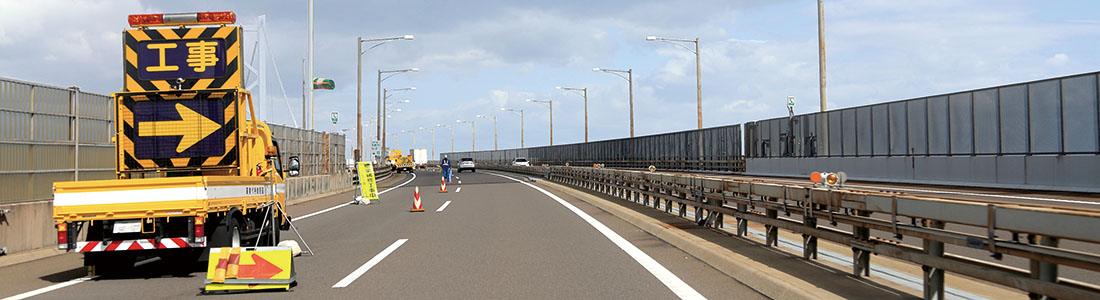
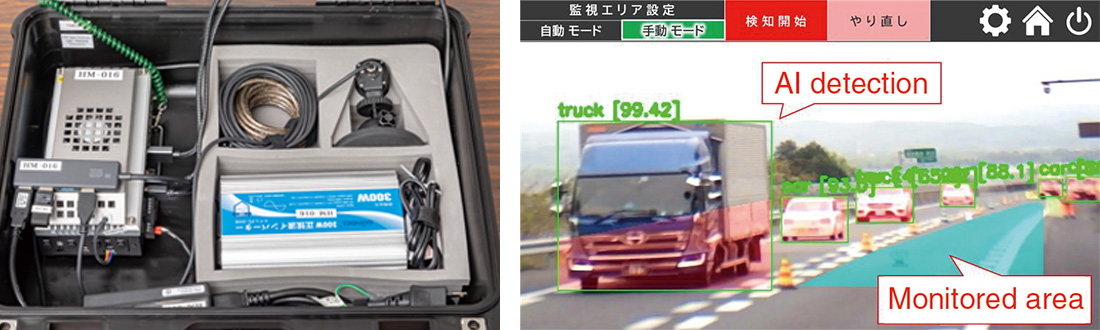 Acting as the “eyes of the system” at highway maintenance sites, Highway Ai-MONITOR provides workers with a strong
sense of safety and reassurance.
Acting as the “eyes of the system” at highway maintenance sites, Highway Ai-MONITOR provides workers with a strong
sense of safety and reassurance.
Ensuring worker safety:
A critical challenge in high
way maintenance
Highways are an essential social
infrastructure that support both the
movement of people and the transport of
goods. Maintaining highways requires daily
inspections, such as checking for damage,
along with repair work and measures to
address aging and wear. However, when
work is performed with only partial traffic
restrictions, prohibited areas are marked
only by arrow boards and traffic cones,
placing workers in life-threatening situations
where high-speed vehicles pass close by.
Highways are an essential social
infrastructure that support both the
movement of people and the transport of
goods. Maintaining highways requires daily
inspections, such as checking for damage,
along with repair work and measures to
address aging and wear. However, when
work is performed with only partial traffic
restrictions, prohibited areas are marked
only by arrow boards and traffic cones,
placing workers in life-threatening situations
where high-speed vehicles pass close by.
“Ensuring worker safety is an ongoing
challenge, and we have implemented
various measures over the years,” says
Yukiharu Aoyama, General Manager of
the Engineering Development Department
at Central Nippon Highway Engineering
Nagoya Co., Ltd., in explaining the
motivation behind developing Highway Ai-MONITOR. “For example, some systems
use infrared sensors to detect intruding
vehicles and alert workers with warning
lamps. However, on highways, a vehicle
traveling at 100 km/h covers 100 meters in
just about three seconds, making it difficult
for workers to react in time even if a hazard
is detected. We have always wondered
if there is a way to improve safety by
detecting intrusions earlier and making
decisions through automated systems
rather than relying on human judgment.
“We develop various equipment
and systems for highway maintenance,”
he continues. “One day, a software
development partner proposed using
AI-based object recognition to detect
dangerous driving vehicles, allowing
preventive action before serious accidents
occur. We then tested an open-source
object recognition model on highways, and
it was able to accurately classify vehicle
types traveling at 100 km/h.
“This gave us confidence that we
could detect vehicles entering restricted
areas quickly and accurately, even at an
early stage.” This led to the official launch
of the Highway Ai-MONITOR development
project.
Hardware Challenges Resolved with the Adoption of DX-U2200
According to Mr. Aoyama, one of the
biggest challenges during development
was how to define restricted areas.
“Highway work often involves moving
gradually along the road under traffic
restrictions, so it is essential to set
the work area quickly and accurately.
Through extensive trial and error, we
developed a function that uses AI-based
image recognition to automatically define
these areas.”
After overcoming these challenges
and moving toward commercialization,
they encountered another major issue.
“We had been using an overseas edge
AI computer in the prototype, but it was
discontinued,” recalls Mr. Aoyama.
Finding an edge AI computer
with stable supply became a critical
requirement for commercialization. During
their search, they discovered Contec’s
DX-U2200.
“Because the system would be
mounted in a vehicle and used outdoors
year-round, we focused on two key
requirements: compliance with in-vehicle
vibration standards, and a wide operating
temperature range. The DX-U2200 met
these requirements and also offered a
compact design, which we found highly
beneficial. Reducing the overall system
size was also important, given that it
needed to be transported in a vehicle.
Compared with overseas alternatives that
raised concerns about supply stability
and support, the DX-U2200 offered the
advantage of domestic production and
reliable support, along with stable supply
of current models regardless of the
Jetson version. The final deciding factor
was the commitment to support the then
non-recommended Jetson Super Mode
through a firmware update, which led to
its official adoption.”

Stable Operation in Field Testing—A Reliable Partner for Future Development
On-site user testing was then conducted
using the product version equipped with
the DX-U2200. According to Yasunori
Taneda, Deputy General Manager of the
Engineering Development Department
at Central Nippon Highway Engineering
Nagoya Co., Ltd., who oversees on
site deployment, “There is always some
initial hesitation when introducing new
equipment on site. However, many users
reported that after using Highway Ai-MONITOR, their sense of safety improved
significantly.” These responses confirmed
the system’s practical effectiveness in
real-world use.
Mr. Aoyama and Mr. Taneda plan
to incorporate field feedback to further
improve Highway Ai-MONITOR, making
it simpler and more compact. As a key
partner in this continued evolution,
Contec’s edge AI computers are
expected to play an important role going
forward.
Implementation Points
Challenges
After overcoming software
related challenges and moving
toward commercialization, the
overseas edge AI computer
used in the prototype was
discontinued. This created a
new challenge: selecting a
product that ensures stable
supply and reliable support.
Results
The product met all required
speci cations and passed all
on-site user tests. Its compact
design also helped reduce the
overall size of the product. The
product received strong interest
from other highway maintenance
companies at trade shows,
creating opportunities for
nationwide deployment.
Customer Profile
- Central Nippon Highway Engineering Nagoya Co., Ltd.
General Manager, Engineering Development Department Yukiharu Aoyama
-
Mr. Aoyama has developed numerous
highway maintenance products with a
flexible and innovative approach. He has a
strong commitment to ensuring the safety
of on-site workers, and as the leader of
Highway Ai-MONITOR development, he
continues to drive further product evolution.
- Central Nippon Highway Engineering Nagoya Co., Ltd.
Deputy General Manager, Engineering Development Department Yasunori Taneda
-
Drawing on his extensive experience as an
on-site worker, Mr. Taneda leads the on
site deployment of Highway Ai-MONITOR.
He also provides accurate feedback from
workers in the field, and works to improve
the product to make it more user-friendly.
-
Central Nippon Highway Engineering Nagoya Co., Ltd.

- Central Nippon Highway Engineering Nagoya
acts as a “road doctor,” responsible for
maintaining highways. The company also
develops equipment and products to improve the
safety and efficiency of maintenance operations.
-
SUN-WA TECHNOS CORPORATION
- As a trading company, SUN-WA TECHNOS
handled various coordination tasks during the
introduction of the DX-U2200. It also made a
significant contribution to selecting the cameras
used to monitor Highway Ai-MONITOR in the field.
Product Info
-
Edge AI Accelerator Equipped with NVIDIA® Jetson™ Orin NX
Powered by NVIDIA® Jetson™ Orin NX, the DX
U2200 is ideal for applications requiring on
site AI inference, such as image inspection
and predictive maintenance.
-
NVIDIA JetPack™ SDK Support
JetPack™ SDK can be used in the same
way as with Jetson developer kits, allowing
applications developed with developer kits to
be run directly.
Return to Implementation Case Studies