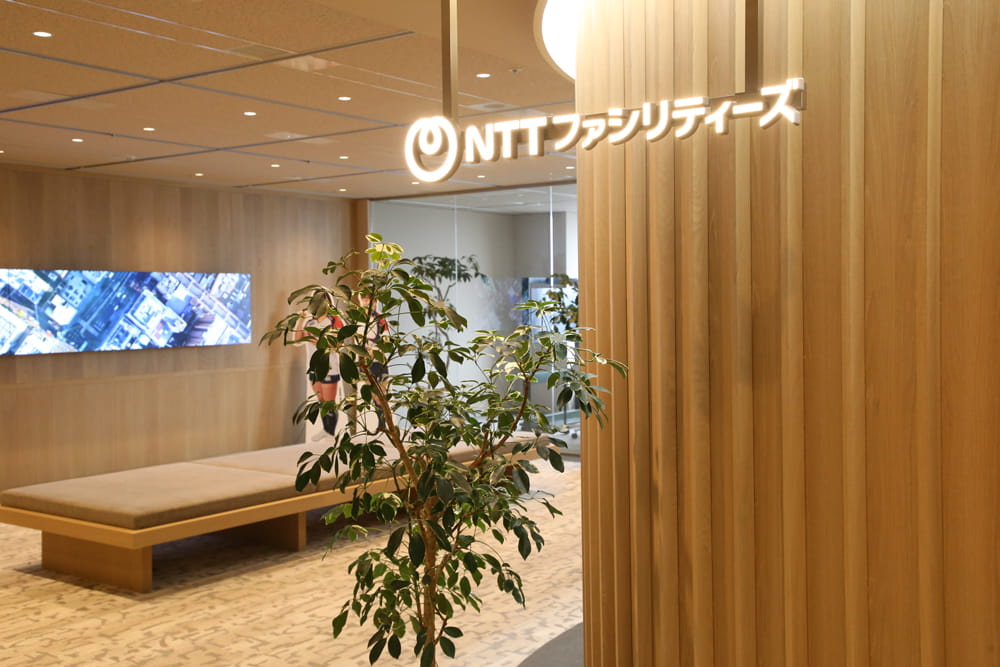
 Entrance featuring the redesigned NTT Group logo for NTT’s new stage in facility solutions
Instant assessment of building safety during earthquakes:Yure-Moni—Inspired by lessons learned from earthquake
NTT Facilities supports buildings and facilities by integrating the strengths of engineering and ICT in Japan, where earthquakes are a major threat to safety. “Following the Great East Japan Earthquake, we received many inquiries from clients who own buildings, especially ultra-high-rise buildings, expressing concerns about the strong, prolonged shaking experienced on upper floors. We could see that there was no apparent danger, but we were frustrated by the lack of an objective way to demonstrate it,” recalls Takeshi Matsushita, Manager of the Service Development Division in the Service Innovation Department at NTT Facilities, Inc. Interviews with building owners showed the need for a service to evaluate the safety levels of buildings, which launched development of this system.
The NTT Group originally constructed its earthquake monitoring network to help ensure uninterrupted communications and has accumulated a wide range of expertise in this area. However, the high-precision seismometers used in systems are extremely expensive, so it was impractical to offer them to customers. To address this issue, a specialized accelerometer for structural health monitoring was developed to measure the deformation on each floor during earthquakes. This data is combined with building structural design data to analyze the degree of damage. This is the core of the Yure-Moni building safety evaluation service. Data from accelerometers on each floor is monitored constantly and aggregated by an edge computer to determine the risk level for each floor in real time during an earthquake.
Building managers or owners may be off-site when an earthquake occurs, so the system can notify them of the situation by email. Yure-Moni was released after a development period of approximately two and a half years and has since been introduced in many buildings. However, serious problems arose several years after the system went into operation.
System Configuration

Part replacement burdening operations: Resolved by introducing a BOX Computer
One challenge was growing demand—driven by the push toward DX—for cloud-based visualization of system statuses in addition to email notifications. Another challenge was maintenance issue associated with the edge computer. According to Matsushita, “At the time, I was using a laptop. Although it was high spec, it was meant for office use. The system was not designed to operate 24/7 so it sometimes became unstable. To ensure stable operation, it was automatically rebooted once a day. However, there is a non-zero possibility of an earthquake occurring during the reboot. We wanted to provide higher reliability for our customers’ peace of mind. Edge computer parts were also deteriorating over time, requiring frequent replacement, which was a significant burden. These factors prompted us to carry out a major redesign.”
The decision to switch to an industrial computer was made early on due to the need for stable, continuous operation, with various products being compared based on three criteria.
Excellent stability and durability, the main purposes of replacement
As compact as possible due to installation space varying from building to building
Cost performance balance
Ultimately, the development and operations team unanimously chose the BX-T1000 BOX Computer. At the NTT Group’s research laboratory, a triaxial shake table was used to reproduce building shaking observed during real earthquakes, including the Great East Japan Earthquake. After durability testing, the system was approved for official adoption.
Results That Exceed Expectations: Contributing to Future Service Expansion
Replacement with the fanless, compact BX-T1000 went smoothly, eliminating concerns about rebooting. The new Yure-Moni with cloud services is now in operation at approximately 200 locations. “Although several years have passed since the redesign, there hasn’t been a single machine problem, drastically reducing the demand for on-site support, which was a pleasant surprise,” said Matsushita.
Future plans for the system include evaluation of risk levels for specific walls or pillars and linking with other IoT sensors to provide comprehensive assessment and information on the condition of entire buildings during all types of disasters.
“Since introducing the BX-T1000, there have been several large earthquakes. Many people mentioned how glad they were to know that everything was safe, demonstrating the peace of mind our services provide. No one knows what will happen when a disaster occurs, so the reliability and stability of on-site edge computers are extremely important,” said Matsushita, expressing his unwavering confidence in the BX-T1000 as a partner.
Implementation Points
Challenges
The edge computer originally adopted for Yure-Moni, but could not operate continuously and require regular reboots. Deterioration over time required frequent part replacement, creating a huge burden. To solve these problems, use of an industrial computer was considered.
Result
Switching to the BX-T1000 allowed for stable, continuous operation. Some initial troubles were anticipated based on previous experience, but there have been zero issues to date, exceeding all expectations. The fanless, compact design that can be used in a range of installation environments has also been highly praised.
Customer Profile
- Takeshi Matsushita
Manager, Service Development DivisionService Innovation Department
NTT Facilities, Inc.
- A licensed 1st-class architect and Structural Design 1st-class architect, he has supported Yure-Moni with his expert insight from planning and development through to operation. He also expressed his intention to continue using the BOX Computer after scheduled OS changes.
- NTT Facilities, Inc.

- Helping to build a sustainable future by offering building and facility design, consulting, and management services with specialists in a variety of fields, including architecture, energy, and ICT.
- Building Safety Assessment Support Service Yure-Moni
- Yure-Moni is a structural health monitoring* service that measures seismic motion by installing acceleration sensors on each floor of a building. It promptly evaluates the safety of the building’s structural frame in three levels based on the measured shaking during an earthquake. This enables quick decision‑making immediately after a seismic event and supports efficient recovery actions that follow.
*Structural Health Monitoring (SHM):
A technology that diagnoses and predicts the condition and extent of damage to structures such as buildings by installing sensors to measure vibrations and other responses.
Adopted Product
Return to Implementation Case Studies